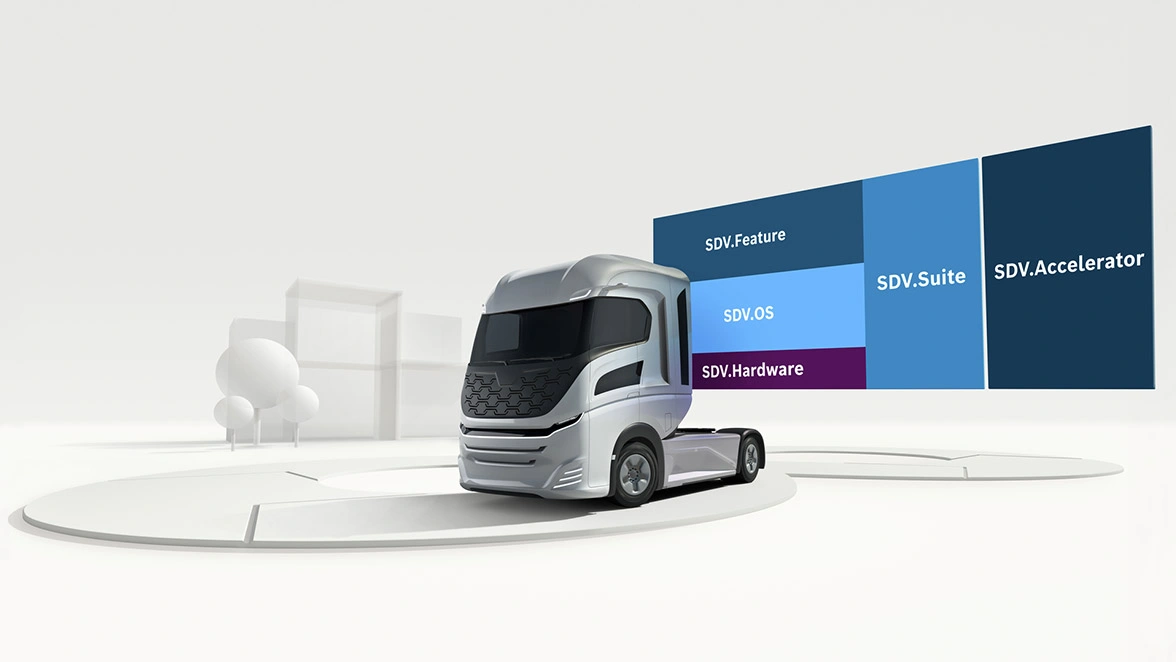
The goal of a software-defined commercial vehicle (SDV) is to scale capabilities without scaling complexity. Achieving this requires a pragmatic architectural foundation that allows vehicle manufacturers to develop, integrate, and deploy software independently of the underlying hardware. This transformation is driven by three core architectural enablers:
Functional distribution
Software-defined architectures decide where a function should run – locally, centrally, or in the cloud – based on safety, performance, data availability, and cost.
Scalable compute
A scalable compute foundation allows vehicle manufacturers to match processing power, memory, and bandwidth to the specific vehicle segment, ensuring demanding features are supported only where needed.
Zonal abstraction
Commercial fleets have high physical variance in wheelbases, powertrains, and bodybuilder configurations. Zonal controllers aggregate these physical interfaces locally, shielding the central software platform from physical complexity.