empty
Bosch Mobility


The mobility world is shifting towards a software-driven future with centralized computing architectures, sustainable energy solutions, and new exciting driving functions. Discover how we're simplifying the development of next-generation vehicles! With our flexible technologies in hardware, software and services, you can develop faster, reduce costs, and integrate innovative features into your vehicles.
We are looking forward to get in touch with you!
Join us and stay ahead: We invite you to join our experts for an exclusive dialogue on our significant innovations.
See the presentation of this topic by our expert Julia Howind.
Vehicle Motion Management is a portable software solution which controls the vehicle’s movement in all six degrees of freedom. By integrating braking, steering, powertrain, and suspension, it creates a new level of driving performance. Powered by AI, Vehicle Motion Management enables a user-centric, self-learning personalized driving experience, adapting to user and situational driving conditions.
See the presentation of this topic by our expert Holger Breuing.
Future features require increased user centricity. Hyper Personalization is our approach to realize that: Automatic adjustments of the mobility experience to individual needs, preferences, interests and context. Truly personalized and contextualized features based on Bosch’s cross-domain knowledge & portfolio are supporting the OEM to offer solutions that enhance the excitement, safety and security.
See the presentation of this topic by our expert Raphael Zimmermann.
Gen AI is redefining cockpit UX, making user interaction more intuitive, personalized, smarter and more human-like than ever before.
See the presentation of this topic by our expert Niklas Ulshöfer.
Electronic suspension control solutions significantly enhance the driving experience, providing optimized ride comfort and stability while contributing to vehicle efficiency. The portfolio includes high performance solenoids, control units, and integrated module solutions for operating the air suspension system. The software-defined vehicle ready products are designed for semi-active damping and air suspension systems.
See the presentation of this topic by our expert Tim Forster.
Act-by-wire technology, which includes brake-by-wire and steer-by-wire systems, replaces the mechanical connection between steering wheel and steering actuator as well as the connection between brake pedal and brake actuators by electrical signal lines. This enables new human machine interface concepts and optimizes the vehicle design with regards to noise, vibration, harshness, manufacturing and safety.
See the presentation of this topic by our expert Florian Gambert.
Explore Bosch’s modular ADAS product family for all vehicle segments (entry, mid, high). Each variant differs in its software scope, services, sensor combinations, and computing power to enhance both safety and comfort. Our scalable ADAS software stack delivers cutting-edge solutions for advanced driving and parking features, empowering OEMs to navigate the complexities of software-defined vehicles.
See the presentation of this topic by our expert Benedikt Staffler.
Discover Bosch’s latest advancements in end-to-end (E2E) AI technology and foundation models. Our platform integrates AI capabilities, optimizing E2E AI while retaining component controllability. Bosch’s ADAS foundation models enable context sensitive perception, enhancing understanding of corner-case automotive situations and improving reactions in critical scenarios.
See the presentation of this topic by our expert Georg Schneider.
The Bosch Airbag 12.3 combines an airbag electronic control unit with integrated high-performance sensors. Its intelligent design meets market demands for inertial measurement unit integration, making it a safe, efficient, and future-proof choice for vehicle electrification and comfort.
Bosch offers peace of mind with its intelligent vehicle submergence detection system. It uses advanced sensors and algorithms to instantly recognize when a vehicle is submerged. In critical situations, it initiates a safe evacuation. By guiding occupants and opening windows, it removes the risk of human error and ensures a swift, reliable escape – even when every second counts.
In the event of a front pole crash, conventional crash detection solutions have limited deployment performance. However, by upgrading from a single-axis upfront sensor to a dual-axis sensor, airbags and belt tensioners are deployed to provide the best possible protection.
See the presentation of this topic by our expert Stephan Rosenberg.
Bosch sets new standards in energy management with its next generation charger-converter, which is fully V2X capable. This innovative technology not only facilitates the charging of electric vehicles using latest semiconductor technologies for highest efficiency, it also enables bidirectional energy transfer.
See the presentation of this topic by our expert Peter Dengler.
Bosch’s scalable eAxle systems with oil-cooled design are highly efficient and come with a compact housing based on a multifunctional platform. They are available as 3-in-1 or 6-in-1, boost variant or main drive at global scale. With innovative software features, differentiation at powertrain level becomes reality.
See the presentation of this topic by our expert Masaaki Suzuki.
When it comes to electric motors, global platforms are the key to success – and this is where Bosch takes advantage of its global presence to become a reliable partner at global scale. Bosch is showcasing different technology advantages for standardized and global platforms – cost competitive and mature with innovative approaches to reduce the product carbon footprint.
See the presentation of this topic by our expert Stephan Rosenberg.
Bosch showcases the next technology leap when it comes to inverter (2-/3-level design) and power module design based on SiC technology, with flexible contact, cooling, and power options (750 V /1,200 V). Explore how Bosch’s power electronic solutions and advanced software features can enhance your highpower applications.
See the presentation of this topic by our expert Peter Spoden.
Bosch’s new generation of high-performance MEMS sensors. The software-defined vehicle will transform the MEMS business model, enabling OEMs to define performance classes and select products. Hardware configurations will be independent of the first owner, with functions available for licensing. The SMU300 MEMS sensor is designed for autonomous driving and precise localization, featuring low noise, zero drift, and durable ceramic packaging.
See the presentation of this topic by our expert Dirk Bangel.
By collaborating with our partners on the SDV.OS platform, Bosch speeds up time-to-market, improves the end-user experience, and cuts costs. This solution provides a consistent and reliable foundation for software delivery, resolving the complex lifecycle differences between customer-facing features and hardware-bound systems. A key enabler is Eclipse S-CORE, which promotes innovation and makes our joint development efforts more efficient and cost-effective.
See the presentation of this topic by our expert Achim Henkel.
A main advantage of SDVs is the fast-improving software, even in the field. Therefore, the application software (app) will be abstracted from the middleware via an application programming interface (API). In an API-based SW-stack, apps can be rapidly developped in QM simulation environment and then be seamlessly deployed in an automotive grade ASIL stack. We demonstrate a complete safe SW-stack from a vehicle computer via zone-controllers down to actuators with millisecond real-time performance.
See the presentation of this topic by our expert Jens Müller.
Unlock the full potential of your vehicle data! Bosch standardized APIs for fleet services enable efficient data exchange for OEMs, 3rd party data providers and fleet operators, standardized data access, and new business revenues. Imagine fuel and energy analytics, managing vehicle care, monitoring vehicle health and enabling driver-based insurance to optimize operations and unlock new possibilities for your customers.
See the presentation of this topic by our expert Björn Reistel.
OSS is a key enabler for the SDV business. ETAS’ enterprise edition of the open source-based software distribution built on Eclipse S-CORE offers features such as certification, integration support, maintenance, monitoring, and enhanced cyber security. It enables faster development cycles by reducing repetitive efforts, increasing re-use and leveraging innovation power of global open source eco systems.
See the presentation of this topic by our expert Felix Pretscheck.
Bosch Compute offers modular E2E solutions for SDVs, covering the full ECU life cycle – from software and system design to continuous integration, testing, and release. By following the “shift-left” paradigm, Bosch is bridging the gap between traditional automotive and modern software practices, ensuring safe, reliable systems with virtualization and fast feedback loops.
See the presentation of this topic by our expert Rob Cheesey.
Modular, secure, and cloud-based service platform for continuous diagnostics and security monitoring to enable proactive issue resolution.
ETAS showcases a cloud-based, modular service platform for Service-Oriented Vehicle Diagnostics (SOVD) that meets the needs of both manufacturers and the aftermarket. The unique combination of remote diagnostics and continuous security monitoring increases efficiency, leveraging cross domain synergies, while enabling proactive issue resolution, reduced downtimes, optimized repair processes, and opening new service opportunities.
See the presentation of this topic by our expert Tobias Peterseim.
The cockpit & ADAS integration platform is a scalable, modular high-performance computer that combines ADAS and cockpit functions in a single ECU or even on one SoC. From the entry-level to the premium segment, this platform offers system-level cost reductions and flexible multi-SoC architectures, while increasing efficiency in computer resource utilization.
See the presentation of this topic by our expert Erik Görres.
Extensive new vehicle features and improved vehicle functions demand distributed computing power and a robust power supply infrastructure. Bosch’s advanced low-voltage powernet solutions provide a smarter power supply, addressing increasing power demands while ensuring functional safety. From 48 V to fully electronic designs, Bosch is driving the future of power distribution, enabling crucial features for the software-defined vehicle such as state-of-art field monitoring and remote maintenance capabilities.
See the presentation of this topic by our expert Alexander Büchel.
How to fulfill the increasing power demand of on-board consumers with 48V lithium-ion battery for powernet?
See the presentation of this topic by our expert Nadine Rosin.
Bosch offers scalable business solutions: EMS and build-to-print services up to classical Tier1 system design. Broad service packs can be added according to flexible customers need for phases of development/engineering, industrialization and production.
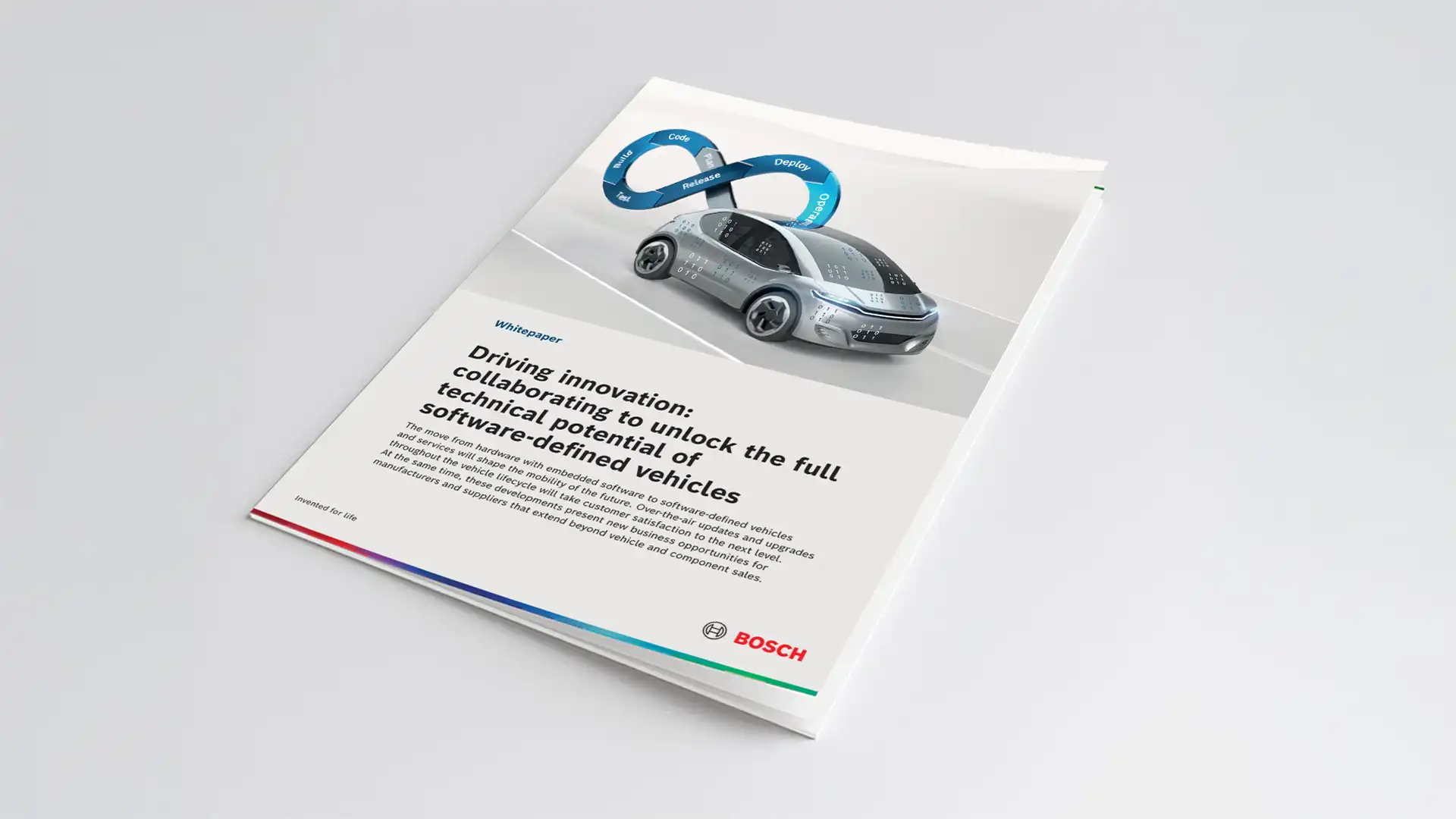
Whitepaper - Driving innovation: collaborating to unlock the full technical potential of software-defined vehicles
The move from hardware with embedded software to software-defined vehicles and services will shape the mobility of the future. Over-the-air updates and upgrades throughout the vehicle lifecycle will take customer satisfaction to the next level. At the same time, these developments present new business opportunities for manufacturers and suppliers that extend beyond vehicle and component sales. Excellence in software engineering is crucial for adapting to evolving user requirements and delivering timely updates and upgrades.
With our combined expertise in multiple domains and regions, we are creating integrated and innovative hardware and software solutions for software-defined vehicles. This whitepaper showcases our broad and modular portfolio and discusses the technical enablers that deliver tangible benefits to manufacturers.
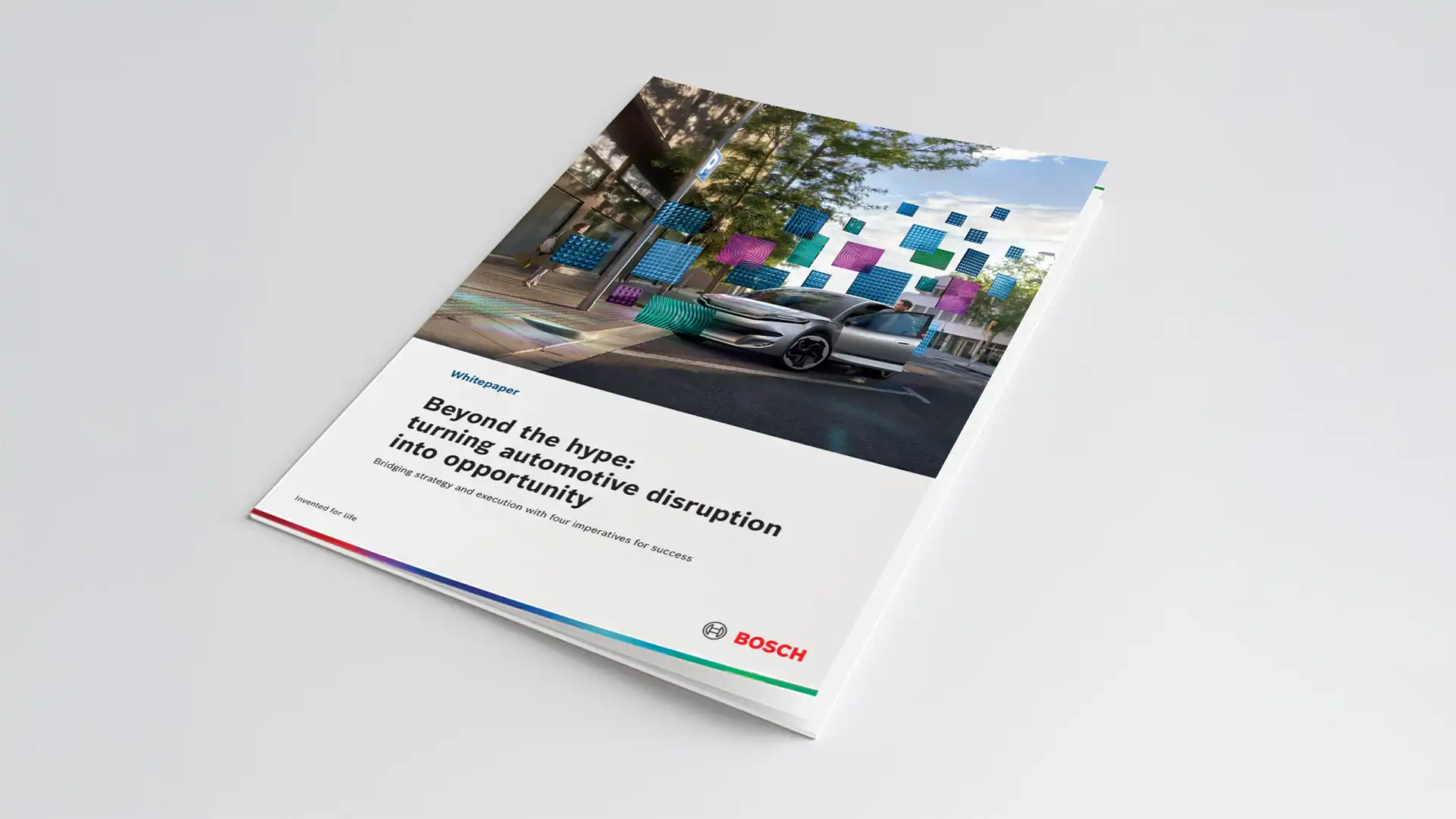
Whitepaper - Beyond the hype: turning automotive disruption into opportunity
The mobility sector is undergoing a paradigm shift, with software becoming the defining factor. Coupled with artificial intelligence, this is leading to faster innovation cycles and an increased focus on the user experience. As a result, vehicles are becoming more and more connected and intelligent as they develop into integral parts of broader ecosystems. While this transformation presents significant opportunities for the automotive industry, it also gives rise to fundamental changes that mobility players must respond to.
Under the headline “Beyond the hype: turning automotive disruption into opportunity” the whitepaper offers insights into how Bosch is navigating this seismic market shift: adapting to local market needs for global success, driving change for the software-defined vehicle (SDV), harnessing the power of artificial intelligence (AI), and fostering key partnerships.
Users of mobility services expect their vehicles to offer more and more features that go beyond what is offered by traditional vehicles. They are looking for a variety of easily accessible, exciting mobility services – just like they are used to from other digital services. The resulting increase in requirements, functions, and amounts of data requires the entire automotive industry to rethink what it means to be an automotive provider. A new era of software-driven, service-oriented mobility has begun, in which software-defined vehicles become part of a comprehensive mobility ecosystem.